DeployLedger
Open source · Release operations & DORA metrics
A self-hosted release-operations control plane: it ingests deployment events, computes DORA metrics and helps decide whether the next release is safe to ship.
Problem
Delivery speed and change stability are hard to judge when deployment data is scattered.
Solution
A FastAPI service that ingests deployment events and computes DORA metrics, with a React dashboard and a hash-linked audit chain.
Built in
Computes all five DORA metrics from deployment events, with a tamper-evident audit chain. Live demo; CI tests the code and scans the images.
Overview
DeployLedger gives a team one clear, auditable view of delivery speed and change stability. Deployment events arrive through a small REST API or verified GitHub webhooks; idempotency keys make repeated requests safe, and every write lands in an append-only, hash-linked audit chain.
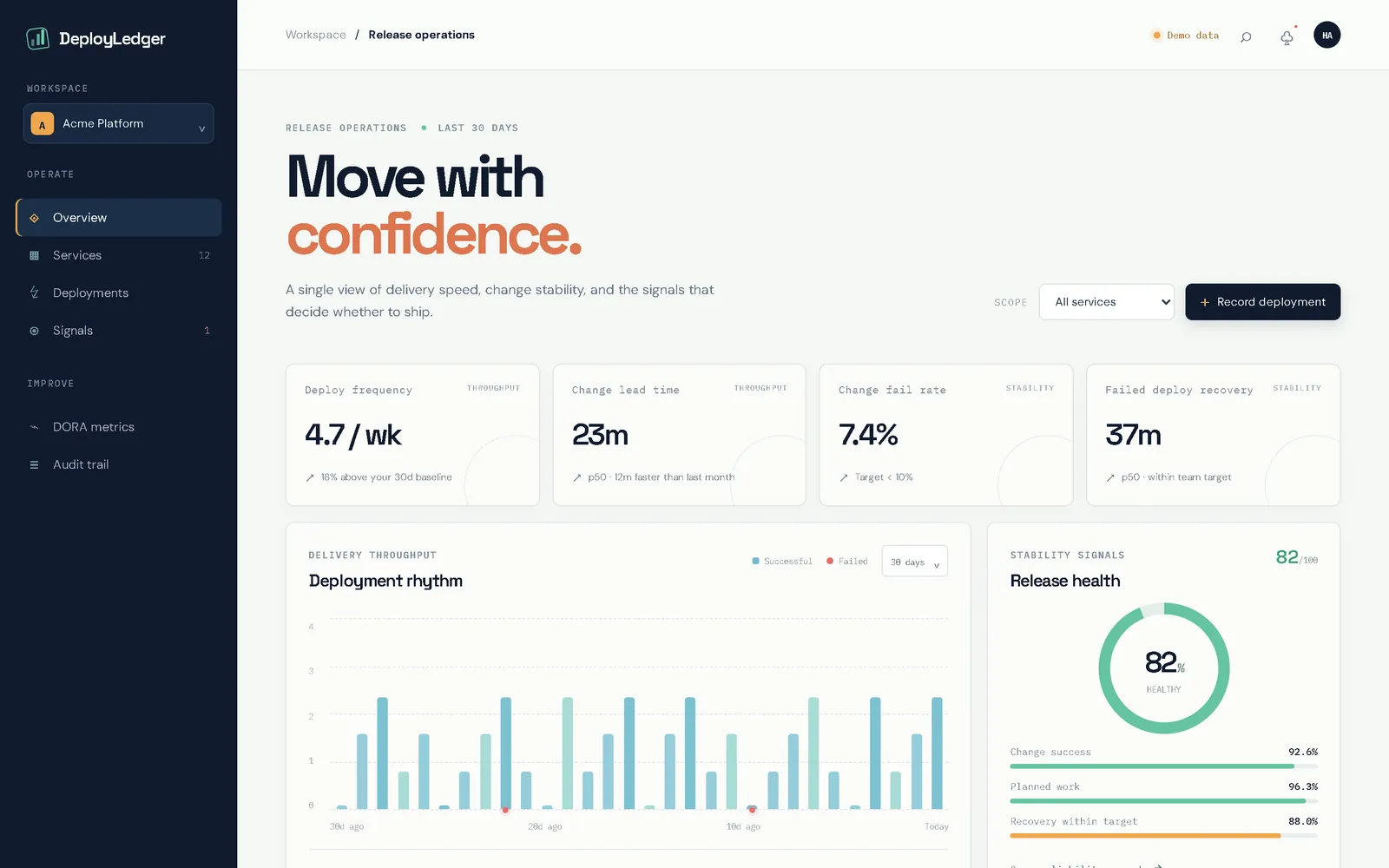
From those events it computes the current five-metric DORA model — change lead time, deployment frequency, failed deployment recovery time, change fail rate and deployment rework rate. The React + Vite dashboard shows the window behind each number, per service and environment, and falls back to clearly labelled demo data when no API is connected.
The project is shaped like a production service: async FastAPI with Pydantic v2, SQLite locally and PostgreSQL in deployment, Prometheus metrics and health probes, HMAC webhook verification, non-root containers with read-only filesystems, Kustomize overlays, an ECS/Fargate Terraform blueprint, runbooks, and CI that tests the code and scans the images.
What it does
- Ingests deployments via API or signed GitHub webhooks, with idempotent writes
- Computes the five DORA metrics with daily trends
- Keeps an append-only, tamper-evident audit chain
- React dashboard with service scoping, an environment matrix and a release feed
What's next
Hiring for a full-stack, Python or AI role — or need something like this built? Let's talk.
I'm available immediately — on-site or hybrid in Moscow, or remote; full-time or contract. I reply within 48 hours — faster on Telegram.