Pulseboard
Open source · Uptime & SLO monitoring
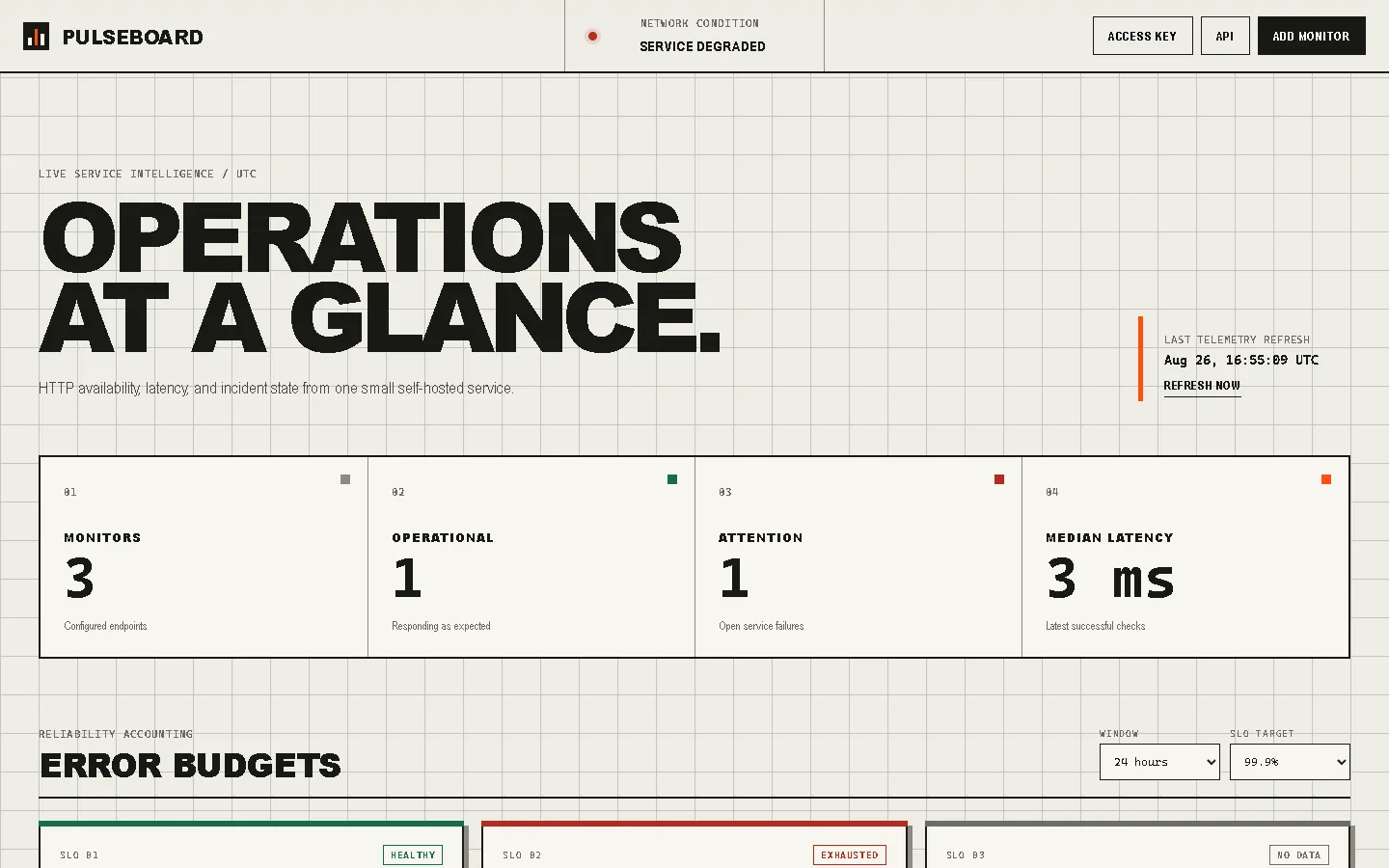
Self-hosted HTTP uptime monitoring with automatic incidents, SLO error budgets, a public status page and Prometheus metrics — all in one container.
Problem
Uptime checks, incident history and SLO reporting usually mean running several separate services.
Solution
One FastAPI service with an async scheduler, SQLite storage, a dashboard, a public status page and Prometheus metrics.
Built in
Tests cover incident recovery, SLO math, access control and SSRF protection. Live demo; one docker compose command.
Overview
Pulseboard is a compact uptime monitor that runs in a single container: the scheduler, API, dashboard and SQLite database need no external services. It checks public HTTP endpoints on a schedule, stores latency and availability, and opens or resolves incidents on its own.
Retained checks become SLO error-budget reports — target, observed uptime, estimated downtime and budget exhaustion over 24 hours, 7 days or 30 days. The same state is available through a responsive dashboard, a read-only public status page that never exposes monitored URLs, a typed JSON API, liveness and readiness probes, and Prometheus-compatible metrics.
The defaults are deliberately safe: private and reserved networks are blocked, URLs with credentials are rejected, redirects aren't followed, and a single environment variable puts every write behind an API key. The test suite runs on an in-memory HTTP transport and covers incident recovery, SLO math, access control and outbound-target protection.
What it does
- Checks HTTP endpoints on a schedule and records latency and availability
- Opens and resolves incidents automatically
- SLO error-budget reports for 24-hour, 7-day and 30-day windows
- Public status page, typed JSON API, health probes and /metrics
What's next
Hiring for a full-stack, Python or AI role — or need something like this built? Let's talk.
I'm available immediately — on-site or hybrid in Moscow, or remote; full-time or contract. I reply within 48 hours — faster on Telegram.